

Orthodontics
First Appointment – Diagnostics
In your first appointment, we welcome you and begin by taking your medical and dental history. A comprehensive dental and orthodontic examination is conducted, and if deemed necessary for further analysis of the case, impressions, photographs, and X-rays are taken. Following the orthodontic analysis, a discussion is held regarding the findings, any specific details, the proposed treatment plan, and we answer any questions you may have. If you have any previous X-rays or relevant examinations, we recommend bringing them with you. The ideal age for the first orthodontic examination is 7 years old according to the American Association of Orthodontists (AAO). If there is no immediate indication for orthodontic treatment, a follow-up diagnostic appointment is often scheduled. Additionally, if deemed necessary, a referral to the dentist or another specialist may be made for procedures that need to be completed before the orthodontic treatment.

Orthodontic Treatment
Orthodontic treatment can be broadly categorized based on age.
Children and Adolescents
Starting at the age of 7, with the eruption of the first permanent teeth, we initiate what is known as preventive orthodontics. This phase aims to prevent orthodontic abnormalities by addressing issues with both teeth and jaws early on. Special removable orthodontic appliances, such as expanders are commonly used in this phase, which typically lasts about a year. Cases in this category may involve skeletal disharmonies between the upper and lower jaws, crossbite, severe crowding, early loss of baby teeth, and oral habits like thumb-sucking. This initial treatment creates favorable conditions for the second phase that follows later, often reducing the treatment time with fixed appliances (braces) and preventing the need for tooth extractions for orthodontic purposes.
Upon the eruption of all permanent teeth, usually around the age of 12, we proceed to the main treatment or the so called second phase. This classic treatment involves braces, with or without a prior preventive first phase. At this stage, we can intervene in jaw relationships, tooth positioning, close gaps, correct impacted teeth, and create a harmonious and functional alignment between the upper and lower jaws and teeth. The majority of orthodontic problems are addressed during this phase, and if significant pre-treatment has been done, it can significantly reduce the treatment time with braces and sometimes avoid extractions for orthodontic reasons.
In advanced adolescence, around the age of 15 and older, orthodontic interventions are still possible, but more invasive solutions may be required, often involving extractions of permanent teeth. Patients in this age group may neglect orthodontic appliances and oral hygiene due to increased school obligations and other socio-psychological reasons, making it challenging to achieve the desired orthodontic results.
At our clinic, we emphasize minimally invasive orthodontic interventions and recommend a first visit at the age of 7 to address orthodontic issues early.
Adult Treatment
Finally, there is orthodontic treatment for adults. It's never too late to improve one's smile. More adults are seeking orthodontic treatment, whether it's retreatment of a relapse case or an entirely new treatment. Before starting orthodontic treatment, it's crucial for patients to address other dental issues, such as periodontal disease, fillings, and other basic dental care. In addition to aesthetic improvement, orthodontic treatment in adults can enhance oral hygiene, improve the alignment and function of teeth, and contribute to overall oral health. Aesthetic considerations play a significant role for adults, and for this reason, we often use ceramic brackets, clear aligners - invisible orthodontics, or a combination of both.
Keep Smiling! Keep Shining!
Orthodontic Appliances
Brackets – Fixed Braces
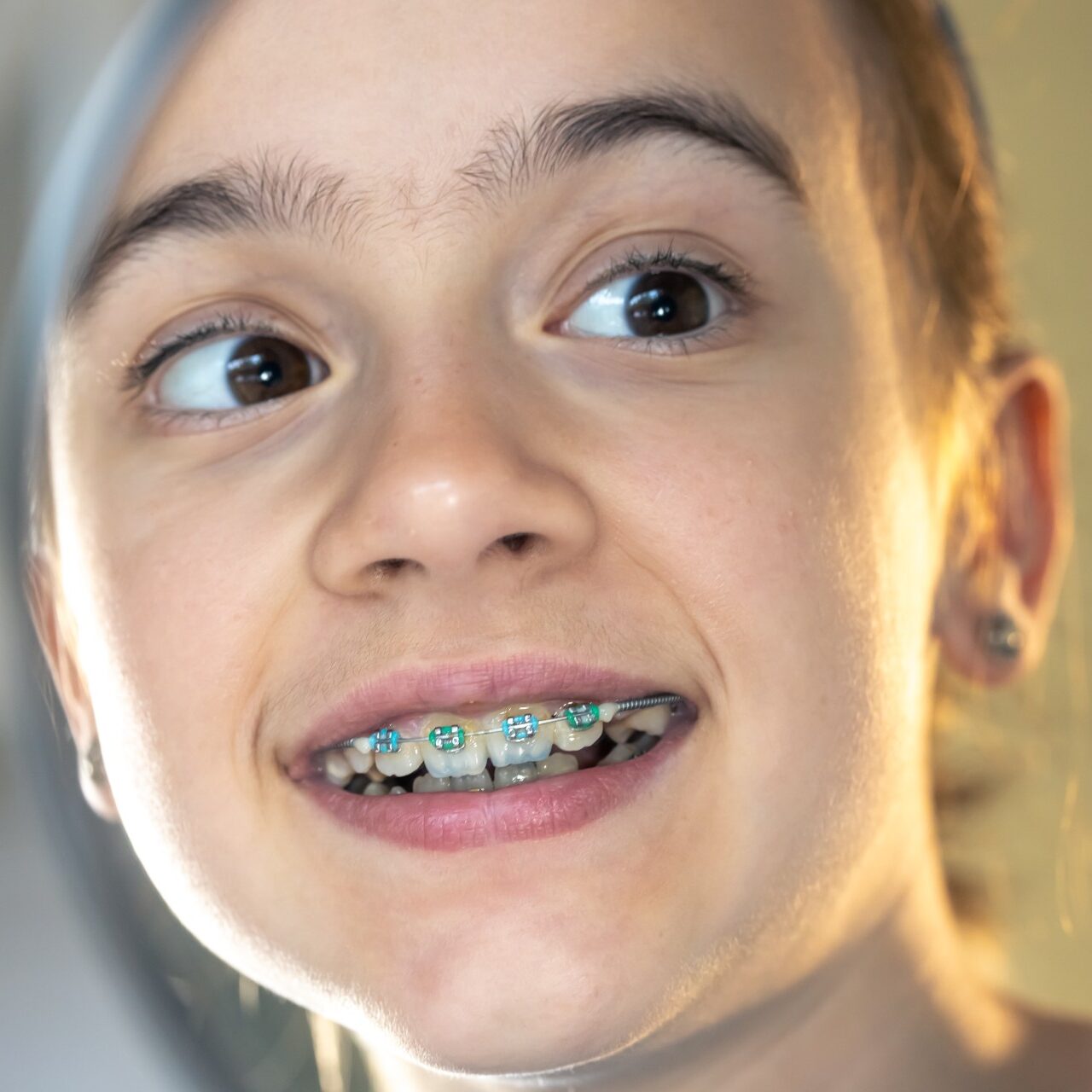
Brackets, commonly known as fixed braces, are widely recognized. They are attached to the external surface of the teeth using a special resin that is removed after the treatment without causing any harm to the tooth. There are traditional metal brackets and the so-called white ones (ceramic brackets) that are more aesthetically pleasing. This method is the most prevalent in orthodontic treatment and, with the help of specialized orthodontic wires, assists in moving the tooth in the desired direction.
Clear Orthodontic Aligners – Invisible Orthodontics
This is a particularly modern orthodontic treatment method based on the gradual orthodontic movement of teeth through a series of clear aligners. It is an excellent alternative to traditional fixed braces and is the most aesthetic solution in orthodontics. The design is done digitally after taking a digital impression with an intraoral scanner (Trios 3Shape). Patients need to wear the aligners for about 22 hours a day and remove them for tooth brushing and eating. It is primarily a solution for adult patients, as the experience shows that consistency/compliance (22 hours a day) in younger ages may not be sufficient. Additionally, most orthodontic problems in younger ages require conventional treatment with braces.
Removable Orthodontic Appliances – Functional Appliances
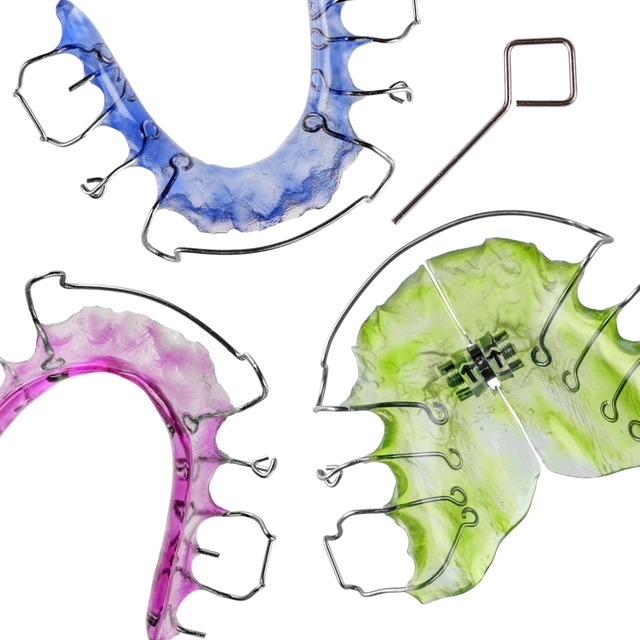
These are specially designed removable orthodontic appliances, commonly known as functional appliances, that the patient can put on and take off by themselves. They are worn for certain hours each day depending on the treatment. Removable appliances have a wide variety and are custom-made according to the patient's needs. They are usually targeted at younger ages and are an integral part of the first phase of addressing jaw and tooth irregularities. The appliances are made of special acrylic and include metallic elements. The patient can choose the color for the appliance and a small figure/logo. Depending on the specific appliance, it should be worn for approximately 8-16 hours a day. Non-compliance with the instructions by the patient may hinder achieving the desired result, emphasizing the importance of patient cooperation.
Fixed Orthodontic Devices
In this category, various fixed devices are included, such as metal orthodontic rings, rapid maxillary expansion devices, upper arch bars, and others. These devices are permanently attached during the treatment and removed upon completion.
Orthodontic Implants
Orthodontic implants are small skeletal implants made of titanium alloy used as skeletal support in demanding orthodontic movements. They are removed after the treatment. Their use has become routine, and their prevalence in orthodontic treatment is increasing.
FAQ
The duration of orthodontic treatment can generally be divided into two periods: the active orthodontic treatment period, involving the active movement of teeth using mobile appliances, transparent aligners, fixed appliances (braces) and the retention period of the therapeutic result using a fixed retainer or removable appliances. The duration of active orthodontic treatment depends on various factors, many of which cannot be fully controlled by both the orthodontist and the patient. Each case is unique, and each patient reacts differently to treatment. The severity of the case, the extent of orthodontic movement, the treatment method, and importantly the patient's consistency in attending appointments and following recommended instructions play a significant role. We employ the most modern methods to achieve the desired therapeutic result as quickly as possible. Due to these factors, it is often challenging to provide an exact duration for the treatment. Treatment is considered complete when the therapeutic goals are achieved. In general, most cases treated with fixed appliances/braces are completed within a range of 16-24 months, while minor aesthetic adjustments in adults using transparent aligners require an average of 9-12 months. Of course, there are cases that may require less or more time. A more accurate duration estimation can be given after the first diagnostics appointment.
After the active tooth movement phase, the stabilization and maintenance of the therapeutic results become crucial. Unfortunately, the oral cavity is subject to lifelong complex factors and mechanisms that may lead to relapse or unwanted tooth movements after orthodontic treatment. For this reason, a lifelong commitment to using a fixed retainer or removable stabilization appliance is recommended for complete maintenance of therapeutic results. It is essential to emphasize that the most critical period for stabilization is the first 6-24 months after active treatment. Although the risk of relapse diminishes over time, it is never completely eliminated. Practically, this means a strong recommendation for retention protocols during the initial 6-24 months, and after two years, patients (or their families) consciously decide whether to continue stabilization, change the retention protocol, or discontinue it entirely. A 100% guarantee of maintaining therapeutic results without some lifelong retention protocol does not exist. Each case is unique, and the level of stabilization need varies with different risk of relapse.
The ideal age for the first orthodontic examination is 7 years old. Both the American Association of Orthodontists (AAO) and international literature recommend this age since the first signs of jaw (facial bone) and tooth development (deciduous or permanent) become apparent.
However, passing this age does not mean it is too late for orthodontic evaluation. Prevention and early diagnosis are crucial, so scheduling the first contact with an orthodontist between the ages of 7-9 is advisable. This initial visit also allows children to become familiar with the examination process, the orthodontist, the environment, and other aspects. Many orthodontic abnormalities can be diagnosed early at the age of 7, and personalized treatment can be applied at the right time with the right means. It is essential to note that not all children after the first examination will undergo treatment. The first orthodontic assessment helps determine the appropriate age to start the treatment if any needed. Modern literature suggests that only a few indications require intervention around the age of seven. The timing of orthodontic intervention is possibly one of the most critical factors in the success of orthodontic treatment in children and adolescents. Orthodontic abnormalities related to the development of facial bones, known as skeletal problems, are challenging to address after a certain age and usually their treatment becomes more invasive later on. Some extreme cases may even require surgical correction. There are international guidelines on which orthodontic pathologies should be treated early and how. In some cases, it is necessary to undergo treatment in stages, in different time periods. An early phase occurs during the mixed dentition stage (deciduous and permanent teeth), followed by a second phase later, when almost all permanent teeth have erupted with a gap of several years between the two phases.
